CHI 97 Electronic Publications: Late-Breaking/Short Talks
Model-Based Design of Hypermedia Presentations
N. Hari Narayanan
Visual Information, Intelligence & Interaction Research Group
Computer Science & Engineering Department
107 Dunstan Hall, Auburn University
Auburn, AL 36849, USA
narayan@eng.auburn.edu
Mary Hegarty
Department of Psychology
University of California
Santa Barbara, CA 94301, USA
hegarty@condor.psych.ucsb.edu
ABSTRACT
Users' mental representations and cognitive strategies have
a profound influence on how well they comprehend
multimodal information that hypermedia systems present.
This implies that cognitive models of comprehension ought
to drive the design of effective Hypermedia Information
Presentation Systems (HIPS). We report on a current
research project that applies this principle to the design of
hypermedia manuals of complex machines. This paper
describes the comprehension model derived from prior
empirical and theoretical research, discusses intermediate
results, and presents a roadmap of the research project.
Keywords
Hypermedia, cognitive models, model-based design.
© 1997 Copyright on this material is held by the authors.
INTRODUCTION
With the advent of cheap and powerful multimedia
computers and hypermedia authoring tools, more and more
information that was traditionally disseminated in the
printed form are being made available in the hypermedia
format. The rate of creation of hypermedia information,
both on the World Wide Web and as CD-ROMs, has far
outpaced developments in the theory of how to design such
systems to best facilitate user navigation and
comprehension of the information being presented. The
design of such systems has largely been guided by common
sense and intuitions rather than theory. Since users' mental
representations and cognitive strategies do influence their
comprehension of multimodal information, cognitive
models that explicate the processes and strategies of
comprehension ought to play a significant role in the
design of HIPS. Indeed, our research is based on the premise
that such a model can provide a principled basis for HIPS
design. We have developed a comprehension model of how
complex machine descriptions are understood from text and
different kinds of illustrations, and are using this model to
inform the design of hypermedia manuals.
HYPERMEDIA MANUALS
Explaining how machines work using the printed book is a
well-established craft since the 15th century. Popular books
like The Way Things Work illustrate this craft of
multimodal explanations - written text interspersed with
various kinds of illustrations. The comprehension task such
books are designed for is that of understanding the structure
(components and connections) and function (kinematics,
dynamics, etc.) of various kinds of machines. One
limitation of the printed medium is that its representations
are static, but the phenomena being explained are kinematic
and dynamic. Another limitation is that readers typically
tend to follow the linear sequence of printed text even when
this sequence may not be the optimal one for
comprehension. Hypermedia presentations are not similarly
constrained. Users can be provided with static and dynamic
presentations and non-linear navigation facilities. How
might one design such a system? On what basis can one
choose to present information using different media (text,
photographs, diagrams, animations, video, etc.), and
structure interaction and navigation? One answer, that of
basing the design primarily on the printed counterpart and
intuitions, is what is found in most current hypermedia
manuals. Another answer, the one we are pursuing in our
research, is to develop a model of comprehension of
machines from multimodal presentations and to use this
model to drive the design of hypermedia manuals.
COMPREHENSION MODEL
The model we have developed views comprehension as a
constructive process in which an individual uses prior
knowledge, information presented in the external media, and
skills of reasoning and visualization to build a mental
model of a machine. Comprehension proceeds in stages.
The first stage involves the decomposition of the machine's
illustration into elementary visual units that represent
various components. The second stage is that of
constructing a static mental model of the machine. This
involves various processes. Following decomposition one
must build referential connections between visual units and
prior knowledge about their real world referents (e.g.,
machine components). One must internally represent the
spatial relations that exist between components. In the
presence of multiple media presenting redundant
information (e.g., text accompanied by illustrations), one
must also make referential connections among descriptions
and depictions with the same referent. Thus, this second
stage involves building various kinds of representational
and referential connections among visual and verbal
information and prior knowledge. Our prior research
[1,3]
indicates that after understanding the static structure, people
tend to follow lines of causal propagation in reasoning
about the kinematics of machines. Therefore, the third stage
is that of determining the causality - potential causal chains
of events in the machine's operation. The fourth and final
stage is that of converting the static mental model into a
dynamic or "runnable" one.
Based on prior research [1,3] we
postulate that this is an iterative process in which behaviors
of individual components are serially inferred, visualized,
and integrated into the static model. See [2] for more
detailed descriptions of the model and the empirical and
theoretical research upon which it is based.
MODEL-BASED DESIGN AND EVALUATION
The utility of such a model and its further elaboration [2]
is threefold. First, the comprehension processes postulated by
the model provide a principled basis for developing
hypermedia design guidelines. For example, the
decomposition stage indicates the importance of
supplementing traditional schematic diagrams with
"exploded" views to facilitate visual parsing. One may
further provide an animation of the explosion and
implosion of the machine - feasible only in a hypermedia
manual - to facilitate parsing even more. Second, a detailed
comprehension model points to potential sources of
comprehension error that users may face, and which the
printed medium, because of its inherent limitations, cannot
counteract. For example, the model indicates that people
tend to visualize component behaviors serially
(see [1,3] for
empirical evidence). This is a potential source of
comprehension error, because most machines have multiple
concurrent behaviors that interact in complex ways. The
corresponding design guideline is to provide two kinds of
animations in a hypermedia manual: one that shows an
accurate serialization of various component behaviors, and
another that shows the actual operation in which many
events take place concurrently. Third, empirically testable
predictions about user behaviors and the effect of design
guidelines on the effectiveness of the hypermedia
presentation can be generated from the model. For example,
given the model's postulation that a serial animation is
more congruent to mental visualization than a realistic one,
one can predict that given both, user behavior will reflect a
preference for the former in terms of access frequency and
duration. Another prediction is that a presentation
containing both kinds of animation will result in better
comprehension than one containing either one alone. Thus,
the comprehension model can inform not only hypermedia
design, but also its evaluation. A complete description of
potential sources of comprehension error and design
guidelines can be found in [2].
CONCLUSION
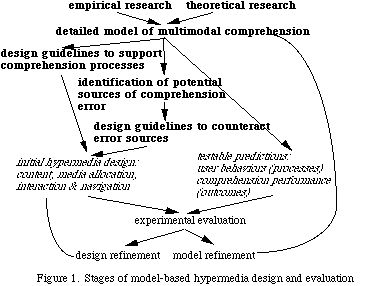
Figure 1 presents a roadmap of this research project, with
bold entries indicating completed work, entries in italics
indicating current research, and plain text entries indicating
future work.
We believe that this approach is broadly applicable to the
design of HIPS to convey static and dynamic properties of
any system, not just machines. A project to test this
hypothesis is currently underway, in which we are using the
comprehension model to design hypermedia algorithm
visualization systems to aid computer science students.
Model-based design is not a new concept in human-computer
interaction or hypermedia. However, models that
are most often used are interface models [5] or system
models [4]. Research reported here addresses the problem of
going from cognitive models to system models of hypermedia
in a principled manner so that system design builds on a theoretical
foundation and is informed by practical guidelines.
ACKNOWLEDGMENTS
This research is supported by the Office of Naval Research
under contract number NAVY-N00014-96-11187 to Auburn University
and contract number NAVY-N00014-96-10525 to University of California.
REFERENCES
[1] Hegarty, M.
Mental animation: Inferring motion from static diagrams of mechanical systems.
JEP: Learning, Memory & Cognition,
18 (5), 1084-1102, 1992.
[2] Narayanan, N. H., and Hegarty, M.
On designing comprehensible interactive hypermedia manuals.
Tech. Report, Comp. Sci. & Eng. Dept., Auburn University, 1997,
Available from authors.
[3] Narayanan, N. H., Suwa, M., and Motoda, H.
Behavior hypothesis from schematic diagrams.
In J. Glasgow, N. H. Narayanan, and B. Chandrasekaran, (Eds.),
Diagrammatic Reasoning: Cognitive and Computational Perspectives.
MIT Press, Boston, MA, 1995.
[4] Special issue on hypermedia.
Communications of the ACM,
38(8), August 1995.
[5] Sukaviriya, N., et al.
Model-based user interfaces: What are they and why should we care?
Proceedings of the UIST'94 Symposium,
ACM Press.
CHI 97 Electronic Publications: Late-Breaking/Short Talks