


|
|
Gregory W. Shirah
Goddard Space Flight Center
Code 522
Greenbelt MD 20771 USA
+1 301 286 7903
greg.shirah@gsfc.nasa.gov
David G. Fout
Century Computing, Inc.
8101 Sandy Spring Road
Laurel MD 20707
+1 301 953 3330
dfout@cen.com
© 1997 Copyright on this material is held by the authors.
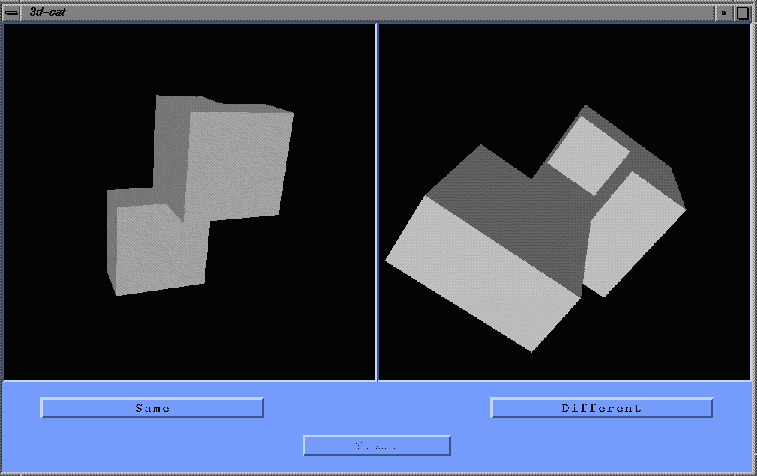
Figure 1: Solid cube-based object image pair.
Presented with pairs of object images, the subjects' task in this study was to determine whether the two images in each pair represented the same or different objects.
Figures 1, 2, 3 and 4 show representative examples of the four types of solid and wire frame, cubical and spherical object images. In each pair, the left image was always stationary and the right image was always in motion. In one half of the trials, subjects could control the motion of the right object. In the remaining trials, the right object rotated automatically.

Figure 2: Wire frame cube-based object image pair.

Figure 3: Solid sphere-based object image pair.
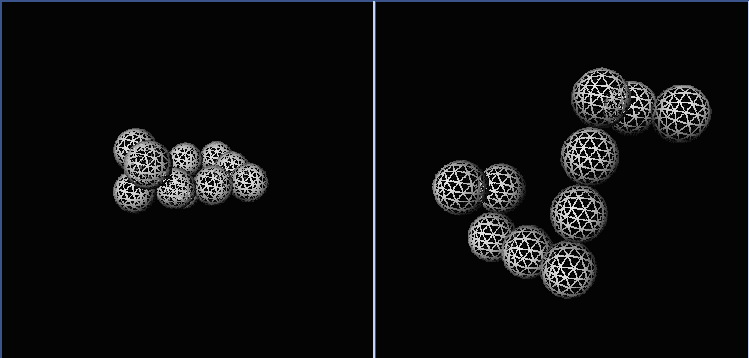
Figure 4: Wire frame sphere-based object image pair.
The experimental design manipulated the independent variables: viewing mode (stereo, mono); type of motion (controlled, uncontrolled); object surface characteristic (wire frame, solid); and object shape characteristic (cube, sphere). Gender (male, female) was used in the experimental design as a between-subjects independent variable. Dependent variables included error rate and response time.
The subjects were 15 male and 14 female professional employees of the Goddard Space Flight Center. Each subject engaged in a total of 208 counterbalanced experimental trials. Factor-referenced cognitive tests [2] were administered to each subject to assess individual spatial orientation and visualization cognitive abilities.
Table 1. Mean error rates and response times.
| Variable |
|
| ||||
| View | Stereoscopic
|
Monoscopic
| ||||
| Motion | Controlled
|
Uncontrolled
| ||||
| Surface | Wire Frame
|
Solid
| ||||
| Shape | Cube
|
Sphere
| ||||
| Gender | Male
|
Female
|
Table 1 presents the mean error rates and response times by viewing mode (stereo, mono), type of motion (controlled, uncontrolled), surface characteristic (wire frame, solid), object shape (cube, sphere), and gender (male, female). Using a repeated measures multivariate analysis of variance (MANOVA) model, there were significant differences (at the 95% confidence level) in the mean values of the dependent variables as a function of four main effects: viewing mode; type of motion; surface characteristic; and gender.
Subjects viewing image pairs in stereo made fewer errors than did subjects viewing the image pairs in mono. Moreover, subjects viewing stereoscopic images made their decisions more quickly than did subjects viewing monoscopic images. Subjects controlling the motion of the right-hand object image were more accurate than were subjects who could not control this motion. However, subjects controlling the motion took longer to make their comparison decisions than did the subjects who could not control this motion. There was no significant difference in the error rates of subjects viewing the wire frame as compared to the solid objects. However, subjects viewing wire frame images took longer to respond compared to subjects viewing solid images. Female subjects made more errors than did male subjects. Moreover, females took longer to make their object comparison decisions than did the male subjects. There were gender-based performance differences in spite of gender-equivalent scores on the spatial orientation and visualization cognitive tests.
There was no a priori reason to suspect that the female subjects would not perform as well as the male subjects. In spite of equivalent gender-based cognitive abilities test scores, the male subjects significantly outperformed the female subjects.
2. Ekstrom, R.B., French, J.W., Harman, H.H., and Dermen, D. Manual for Kit of Factor-Referenced Cognitive Tests. Educational Testing Service, Princeton, N.J., 1976
3. Gallimore, J.J., and Brown, M.E. Visualization of 3-D computer-aided design objects. International Journal of Human-Computer Interaction , 4 (1993), pp. 361-382.
4. Shepard, R.N., and Metzler, J. Mental rotation of three-dimensional objects. Science 171 (1971), 701-703.
5. Sollenberger, R.L., and Milgram, P. Effects of stereoscopic and rotational displays in a three-dimensional path-tracing task. Human Factors 35, 3 (1993), pp. 483-499.
6. Ware, C., and Franck, G. Evaluating stereo and motion cues for visualizing information nets in three dimensions. ACM Transactions on Graphics 15 (1996), pp. 121-140.
|
|