CHI 97 Electronic Publications: Late-Breaking/Interactive Posters
Usability Testing of System Status Displays for Army Missile Defense
LTC Micheal Perrin
THAAD Program Office
PO Box 1500
Huntsville, AL 35807, USA
+1-205-895-3467
Perrin-MD-Th1@thaad1.army.mil
Bobby Ford
THAAD Program Office
PO Box 1500
Huntsville, AL 35807, USA
+1-205-895-3282
FordB@thaad-md.army.mil
Dick Steinberg
W.J. Schafer
1500 Perimeter Pkwy
Huntsville, AL 35801, USA
+1-205-721-9572
dsteinberg@wjsa.com
ABSTRACT
Modernizing workstations for Military applications is a challenge:
designers must increase performance without affecting safety in any way.
Furthermore, interaction efficiency is required to avoid fatigue and minimize
error rates which could cost lives. Soldiers are understandably reluctant to
use a new interface design on systems where life critical decisions are made.
It is paramount to obtain user assessment of Interface Designs early and
continually throughout the software development cycle to insure user acceptance
and optimize user performance. Statistical based usability tests were
performed with soldiers to determine display designs for the U.S. Army's
Theater High Altitude Area Defense (THAAD) Radar Soldier User Interface.
Keywords
Usability Testing, Icon Testing, Perception
© 1997 Copyright on this material is held by the authors.
TOP LEVEL STATUS MONITORING USABILITY TEST
Our objective for this usability test was to determine the quickest method for
the operator to perceive and make corrective actions for a hardware anomaly. To
achieve the objective, the user interface must instantly get the operator's
attention if there is a problem, and it must accurately lead the operator to
the solution. As in other real-time applications, it is crucial to avoid
overwhelming the operator with unnecessary information. The following three
formats were devised (Figure 1-3).
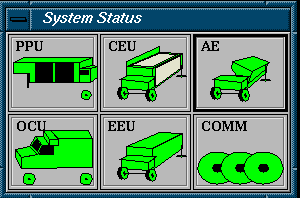
Figure 1.
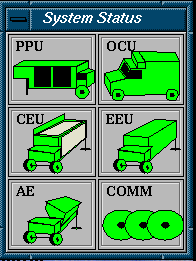
Figure 2.
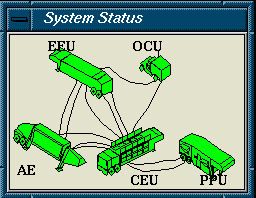
Figure 3.
A multi-level display concept was implemented to give users the capability to
obtain detailed information as required. This display concept uses the
philosophy that monitoring of most systems will not be required unless an
off-nominal condition exists. If any parameter within a system goes to an
off-nominal condition, the system icon and respective portion of the hardware
component will turn yellow or red depending on the severity of the anomaly.
This will alert personnel to select the icon and assess detailed information
pertaining to the system.
TEST RESULTS
Fifteen soldiers from the U.S. Army Fort Bliss 1/6 ADA Battalion were asked to
select the component with an off-nominal condition. To eliminate the factor of
variance for the power of law of practice, the formats were tested in random
order. The data revealed that format three offered users the best performance
in terms of response time (p=0.09) (Figure 4). It is concluded that format
three be implemented for the overall equipment monitoring of system
components.
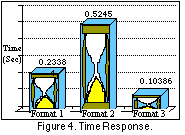
Figure 4.
LOW LEVEL STATUS DISPLAY USABILITY TEST
Once the user determines which overall system component is off-nominal,
the next step is to determine which individual hardware component needs
attention. A typical method for displaying component status is to use a solid
color label and employ color coding of the background to display operating
condition. Changing the background color changes the legibility of the
alpha-numeric text which can be a major problem for time-critical monitoring of
the system. Previous research recommends that changing an object or icon
adjacent to the label provided a better method to display status of the
system[1]. This usability test focused on what icon should be used to display
hardware status. Several icons were designed and developed by a mixture of
Human Computer Interaction specialists in conjunction with soldiers and include
the following: Color-coded light bulb, Horizontal traffic light, Vertical
traffic light, Breaker switch, and Thumbs-up and thumbs-down (Figure 5).


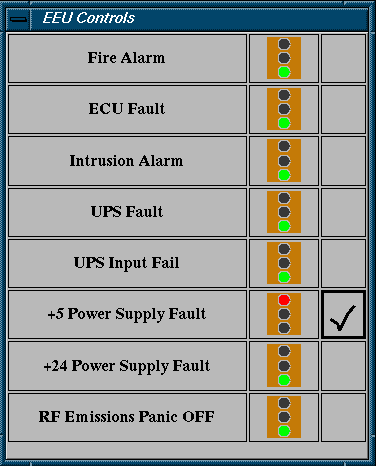
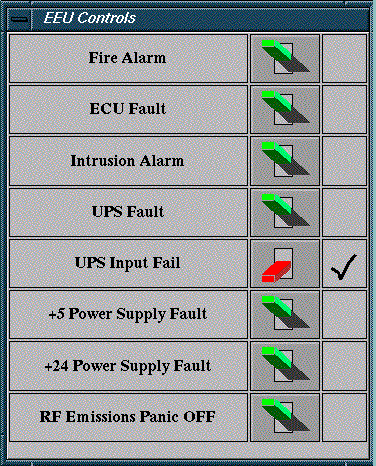
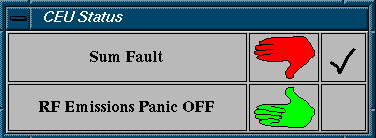
Figure 5.
TEST RESULTS
The same soldiers used for the previous test were tested using five different
formats. Analyzing this result made it evident that the user response was
greatly affected by screen geography of the test buttons. This resulted in
scaling the data using Fitt's law which states that the time for an operator to
move the cursor to a target of size S which lies a distance D away is given by
empirical equation [2]. The scaled values were then analyzed to determine if a
best icon from this set could be found. Although, the soldiers expressed least
preference for the traffic lights as a status indicator, the results
demonstrated that the horizontal traffic light offered the lowest response
time(p=0.110)(Figure 6).

Figure 6.
CONCLUSIONS
The horizontal traffic light, although least preferred, provided the soldiers
with the best performance. This disassociation between soldier preference and
performance emphasizes the need for performance based testing for soldier
computer interfaces. The results from the data are being used to design
graphical presentations which optimize performance for the THAAD system status
monitoring displays.
References
1. Card, S.K., Moran, T. P., & Newell, 1983, The Psychology of
Human-Computer Interaction, Lawrence Erlbaum Associates, Publishers.
2. U.S. Department of Defense (DoD). 1994. Technical Architecture
Framework for Information Management (TAFIM). Volume 8. Human Computer
Interface Style Guide. Version 2.0.
CHI 97 Electronic Publications: Late-Breaking/Interactive Posters