CHI 97 Electronic Publications: Development Consortium
Hypermedia Extension Based on Recursive Abstractions
Vladislav Valkovsky, Dmitry Krechman, Igor Nikiforov, Dmitry Chenosov
Department of Software Engineering and Applications,
St.-Petersburg State Electrotechnical University,
prof. Popov str. 5, St.-Petersburg, 197376, RUSSIA
{Vlad, Dimak, Nis, Che}@ailab.etu.spb.ru
Keywords
Hypermedia, navigation, structural analysis, abstraction
INTRODUCTION
There are many well documented problems facing the ordinary user, as opposed to the enthusiast, of Hypermedia (HM) technology which can lead these users to be frustrated by, or give-up using hypermedia technology altogether. Among these classic HM problems are: the Framing Problem, Framing And Intercomparision Combined, Link Types, Versioning And Historical Backtrack, Closed Context and Open Media, Adding These Aspects Later, Disorientation [3], Information Structuring Systems [2], Visualizing [4]. This paper focuses on one of these key problems, "the Framing Problem" - as the number of hypermedia objects grows the problem of restricting our attention to only the relevant connections becomes harder [3]. How can we structure the source hypermedia to show semantically related clusters? By solving this problem it is possible to offer new ways for people to search and browse hypermedia.
© 1997 Copyright on this material is held by the authors.
EXTENDED HYPERMEDIA
We shall show basic differences between a text, hypertext and hypermedia and how HM can be extended.

Figure 1. A Text
If a text is a sequence (1D) of characters or words (Figure. 1) then Hypermedia has two dimensions (2D) - a sequence of words & associations between words or media chunks (Figure 2).The main idea of the Extended Hypermedia is to extend this two dimensional hypermedia model by adding a vertical component (Figure 3). This component represents the generalization of abstractions that exist within the elements.
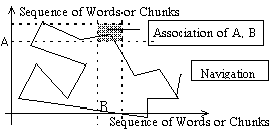
Figure 2. Hypertext or hypermedia
This tree of the categories of the subject domain that we construct is the meta-information structure and it describes the general (or knowledge) structure of the subject domain.
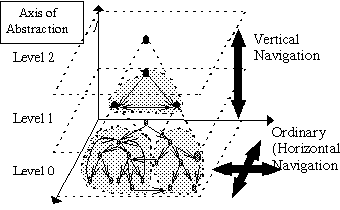
Figure 3. A Extended Hypermedia
In The Extended Hypermedia (3D) a sequence of words, associations between words or chunks, & the meta-information structure, expand the generalized knowledge in the HM. (Figure 3). We have to say, that in our paper this three-dimension model is used not from a geometric point of view, but as an illustration to demonstrate the kind of non-linearity suggested by model. We can look at how this extended Hypermedia model compares with the more usual hypermedia model for solving the classic HM problem - What do I do when I am lost? In the usual Hypermedia model, I move from concept to concept within the hypermedia by following the links. In the extended Hypermedia. I get an overview of the structure of the hypermedia, and can browse the general clusters that describe the content of the hypermedia. When I find the concept that describes what I am looking for, I can move down a level and further explore the details. Thus, in extended HM I use vertical navigation between different levels of abstraction [1] for searching and browsing (Figure 4). Obviously this new approach is only useful if it has advantages over previous approaches. To do this let us examine how this extended hypermedia system with its 3D navigation support [5] solves some of the main classical hypertext problems [3].
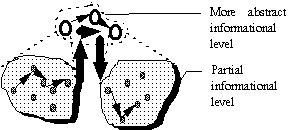
Figure 4. Navigation process with 3D
The main advantage of the 3D approach is the opportunity to browse and search at a more general level if what is being searched for cannot be found at the current level. Furthermore, the user can move between at the more general level, and the more detailed level within the hypermedia, and in this way explore the details of anything they find at the abstract level. In this paper we present some solutions for classic hypermedia problems using this 3D metaphor. In particular - the disorientation, and also, the framing problem (described above) which is also of great importance in the 3D approach. By solving the framing problem we can propose acceptable solutions for other hypermedia problems. In reality we cannot use abstraction because the expense of building the abstraction structure is too great. We propose a set of procedures for automatic building of the abstraction tree (meta-information structure) based on analysis of the interconnections between the subject domain elements (hypermedia structural analysis)[1, 4]. Using a statistical procedure, closed context (subsets) are formed. The semantics of the subsets is built using combinatorial algorithms based on decision of Set Partition Problem (SPP). We can apply SPP to search the optimal set of non-intersected hypermedia frames (in this case needed a numerical estimatations of all possibles frames). The framers built through this process describe the semantics and can be (and have been) used for different goals such as improvement of visualization or conflict resolution [5].
TESTING & ESTIMATIONS OF 3D APPROACH
We will describe the results of our experimental testing with users. To verify the correspondence between the results of automatic processing and user's estimations, we had users make manual generalizations of a subject domain. Then we compared the results of this manual generalization with our automatic generalization. We found that the versions suggested by users are close to the version made by our program. This was statistically significant with a confidence probability of 95% using the Kolmogorov-Smirnov statistical criterion and confirms accordance between the manually generated results and results of the automatic generalization.In the next part of our experiment we estimated the flexibility of this automatic generalization. We presented our automatically generated version to the users and asked them if they agreed with such a variant or not. We must not forget that our mind is subjective with respect to a subject domain and the sense of the source text example (generated by the authors) could be different. The results will be presented.
CONCLUSIONS
In this paper we have shown that by forming a meta-information structure and general/partial criteria it is possible to solve the main HM problems. The key problem is the framing, that is the formation of the initial graph subsets. The meta-information structure is built by those subsets. We have shown the general view to solving classic HM problems in the 3D approach and the quantitative results we have from our experiments. The results suggest that our automatically generated structure corresponds to the kinds of structures generated by people and therefore we think that such a structure may be useful for improving the understandability of a subject domain.This results could be used as the subject of analysis for detection and correction of mistakes in subject domain. It is worth saying, that the results described in this paper are mostly interesting for large dynamic HM systems, which are developing in evolutionary style. In such systems when searching and browsing old paths could disappear, new paths could appear and the user could find themselves in front of a "closed door" at any moment. The approach described here has been embodied in the HyperMethod system.
ACKNOWLEDGMENTS
Thanks to Rachel Bellamy for support of this work.
REFERENCES
1. Foller J., Backer, D., Dargahi, R., Kouremajiam, V., Gilson, H., Brook Long, K., Petermann, C., Gorry, A.G. Experience with the Virtual Notebook System: Abstraction in Hypertext. in Proceedings of CSCW'94 (Chapel Hill, USA, October 1994), ACM Press, 133-143.
2. Haake J.M., Neuwirth C.M., Streitz, N.A. Coexistence and Transformation of Informal and Formal Structures: Requirements for More Flexible Hypermedia Systems. in Proceedings of ECHT'94 (Edinburgh, UK, 1994). ACM Press.
3. Nelson, T.H., Literary Machines, New York, 1990
4. Rivlin, E., Botafogo, R., Schneiderman, B. Navigation In Hypersapce: Designing A Structure-Based Toolbox. Communication of the ACM, N 2, February 1994, Volume 37, 87-96.
5. Valkovsky, V.B., Krechman, D.L., Nikoforov, I.S., Chenosov, D.S. The Processing of Recursive Generalization in the Construction of Hypermedia Macrostructure. in Proceedings of HCI'95. Lecture Notes in Computer Science (N1015), Springer Verlag, Berlin, 1995, 166-178.
CHI 97 Electronic Publications: Development Consortium