


|
|
© 1997 Copyright on this material is held by the authors.
Another direction is to develop a more natural interface. Approaches include (1) cognition-based interfaces that support query by image examples, and (2) descriptive semantics-based approach in which users pose queries by describing target image semantics in a somewhat ``natural language" fashion. This type of interfaces has an advantage of being natural to users, but it has disadvantage of low precision because queries are ambiguous to computers.
We argue that there is a gap between these two directions. We believe a query interface that can visualize queries and also support precise manipulation is essential to effective image retrieval. Moreover, image data is semantically richer than the traditional data forms. The fact that segments in an image have associated semantics and they constitute meaningful structures is ignored by most systems. Users should be able to query objects with finer granularity than a whole image.
The cognition-based approach can visualize queries but it can not support generalized concepts, such as transportation. The semantics-based approach is more appropriate in expressing generalized concepts. However it has a low visual expressive capability. We believe both visual and semantics expressive capabilities are essential in image retrieval.

Figure 1: IFQ as a Visual Query Interface
Figure 1 shows an example in which a user wants to retrieve an image containing a person and a computer where the person is to the right of the computer. There is a gap between the concept in her mind and actual images stored in a database system. Her concept is more natural, but rather ambiguous to the database system. Effective retrieval of images requires a more precise query language. However, this type of manipulation language is usually not user friendly.
IFQ (In Frame Query) is an attempt to bridge this gap. IFQ is a visual interface for SEMCOG (SEMantics and COGnition-based image retrieval system), an object-based image retrieval system. In SEMCOG, the queries are posed by specifying image objects and their layouts. IFQ allows users to query objects with finer granularity than a whole image and specify spatial relationships between objects. IFQ also aims at integrating semantics and cognition-based approaches to give users a higher flexibility to pose queries.
The user's query can be simplified as a visualization model shown at the top of figure 1. She then specifies this visualization model using IFQ using either visual examples or semantics. An actual window dump of IFQ for this query is shown in the middle of Figure 1. This query is then translated (by IFQ) to CSQL (Cognition and Semantics-based Query Language) query, a SQL-like query language used in SEMCOG. The CSQL query is precise to the database system.
In IFQ, objects are represented as bullets and descriptors are represented as small bullets, attached to these objects describe the properties of the corresponding objects. figure 2 shows an IFQ query ``Retrieve all images in which there is a man to the right of a car and he looks like this image". The IFQ query is posed as follows: The user introduces the first object in the image. and then further describes the object by attaching ``i_like image;" and ``is man" descriptors. After a user specifies a image path or provide a drawing, the interface automatically replaces the descriptor with the thumbnail size image the user specifies. Then, the user introduces another object and describes it using the ``is car" descriptor. Finally, the user describes the spatial relationship between these two objects by drawing a line, labeled by to-the-right-of, from the man object to the car object. Please note that while user is specifying the query using IFQ, the corresponding CSQL query is automatically generated in the CSQL window. Users simply pose queries by clicking buttons and dragging and dropping icons representing entities and descriptors.
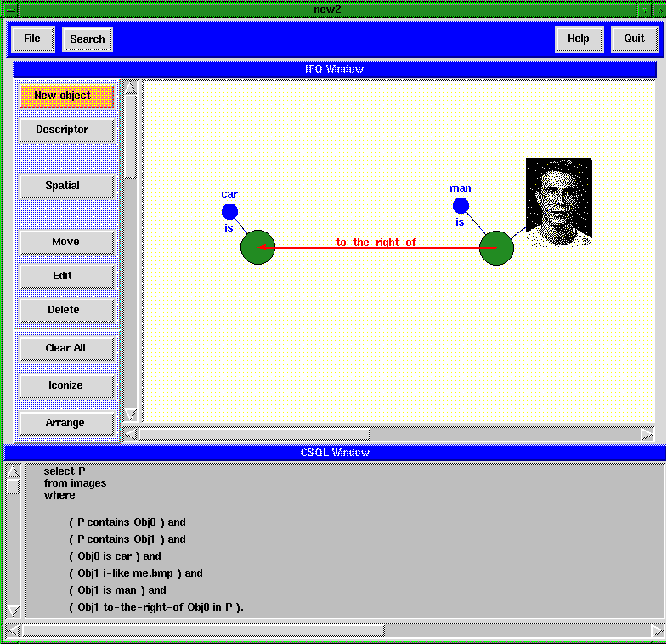
Figure 2: IFQ Visual Query Interface

Figure 3: Relaxed Query for Extracting Semantics
 Figure 4: Query Result
Functionalities supported by IFQ include:
Query results contain thumbnail size images ranked by their degrees of confidence. Users can click on any thumbnail image to see the real image as shown on the right side. However, in many cases, users do not have specific target images in mind. Users want to extract and browse semantic and information about image objects. This form of interactions is supported through extracting semantics and relaxing queries. Users can relax the condition of being a car to ``being a kind of transportation", and introduce an unbound descriptor out4 to check the actual semantics as shown in Figure 3. Figure 4 shows two candidate images including an image containing a bus. This image has a lower confidence, because the human in the image can not be identified as men.
This demonstration shows a novel interface for object-based image retrieval. IFQ integrates semantics and cognition-based retrieval approaches to give users a higher flexibility for describing objects in the query. IFQ is a visual interface to bridge the gap between users' perceptive concepts and direct manipulation query languages.
|
|



