

|
|
We demonstrate our CD-ROM, "Digital Photography at Lincoln High School: An Interactive Ethnography," as well as a web-based example of interactive ethnography. The goal of the work is to demonstrate a new medium for presenting the results of ethnographic studies to a wide audience. The richness of the ethnographic experience is easily lost in a text-only format. The CD-ROM uses audio, video, text, QuickTime VR, scanned images and digital photos to bring alive the experiences of the students and staff in the digital photography class.
Multimedia, ethnography, CD-ROM, digital photography.
© 1997 Copyright on this material is held by the authors.
This demonstration shows the results of an ethnographic study of a
digital photography class at a high school in San Jose, California.
The purpose of the research was to understand how multimedia can be
effectively taught and used in the high school classroom. Our
audience for the research was teachers, school administrators,
technology coordinators, and parents who want to learn how to
integrate technology into the high school curriculum. The information
was also useful for sales and marketing specialists within Apple.
Ethnographic approaches [2,3] are more and more popular in HCI
studies (as evidenced by the tutorials, workshops and papers at
recent CHI conferences; see also [1,9]) but there is often a problem
in effective presentation of results to those who are not social
scientists. Most people are understandably not excited about wading
through lengthy text descriptions of the study population and its
activities. And yet ethnographic information can be extremely
valuable for designers, engineers, managers, marketing specialists
and others who want to understand users and customers [see 4, 5, 6,
7, 8, 10]. We spent five months in the classroom (during 1995) and
felt that writing a paper would not convey the richness of what we
observed and learned to our audience. We decided instead to create a
CD-ROM to show the breadth and depth of the students' experiences
with computers and multimedia.
The CD-ROM contains the students' digital photos, video of classroom activities, audio and video interviews with students, the teacher, and the technology coordinator, QuickTime VR scenes of the classroom, a time line of the curriculum and classroom activities, and scanned images of the curricular materials used by the teacher. The CD-ROM conveys:
The CD-ROM is divided into five major sections:
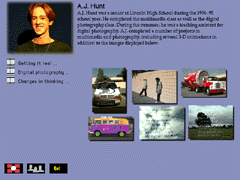
The Introduction contains a video of the Multimedia Program at Lincoln produced by the students; our videotaped comments on the research and what we learned; and text descriptions of the school, the Program and facilities. The Background contains videotaped interviews with the technology coordinator and a list of the equipment used in the program. Student Work profiles eleven students in depth, and includes their digital photos, video- and audiotaped interviews, and photos of the students in the classroom (Figure 1). The Galleries highlight different assignments used by the teacher and show student work for the following assignments: Colorizing, Manipulation, Architecture, CD Covers, Retouching, and Advertising. The Curriculum shows a time line of classroom activities for one semester, with scanned images of the handouts, a description of the activities and some photos.
It is no small undertaking to create a CD-ROM with the amount of content we have. Skill in user interface design, good multimedia tools and lots of testing are essential. We advocate that social scientists learn the requisite design skills as part of their training, and/or partner with those skilled in their use.
We regard the CD-ROM as a success story for ethnography. Apple is using the CD-ROM as a tool for sales and marketing people, selling it (at cost) to customers via our price list, giving copies to our K-12 trainers who train teachers in technology use, and giving copies to the K-12 teachers we support as "Distinguished Educators." The study results will help people to understand exactly how multimedia can be used in the classroom, show them what is possible, and provide practical help in curriculum development. Ethnographers conducting HCI studies can help support their organizations and make the results of ethnographic studies more accessible to a wider audience through the strong presentation format of a well-designed CD-ROM. While the focus of our CD-ROM happened to be marketing and educating customers, the same principles apply to using ethnographic research as input to designers and engineers.
We thank the students and staff at Lincoln High who opened their classroom, minds and hearts to us. Ms. Patricia Lynch, the digital photography teacher, gave us her full support and the pleasure of watching a pro in action. Mr. Clifford Herlth, who started the Electronic Arts Program at Lincoln, showed how American public schools can be innovative when they want to. As for the students, the future is in good hands.
1. Blomberg, J. et al. Ethnographic field methods and their relation to design. In D. Schuler and A. Namioka, (eds.). Participatory Design. Lawrence Erlbaum, 123-155, 1993.
2. Glaser, B. and Strauss, A. The Discovery of Grounded Theory: Strategies for Qualitative Research. New York: Aldine, 1967.
3. Hammersley, M. and Atkinson, P. Ethnography Principles in Practice. London: Tavistock Publications, 1983.
4. Hughes, J. et al. The role of ethnography in interactive systems design. interactions. April, 1995.
5. Ireland, C. and Johnson, B. Exploring the future in the present. Design Management Journal . Spring Issue, 57-64, 1995.
6. Johnson, P., Johnson, H., Wilson, S. Rapid prototyping of user interfaces driven by task models. In Scenario-Based Design, J. Carroll, (ed.) New York: Wiley, 1995.
7. Kidd, A. The marks are on the knowledge worker. In Proceedings CHI'94 (Boston, April 1995), ACM Press.
8. Maltz, D. and Erlich, K. Pointing the way: Active collaborative filtering. Proceedings CHI'95 (Denver CO, May 1995), ACM Press.
9. Nardi, B. (ed.) Context and Consciousness: Activity Theory and Human Computer Interaction. Cambridge: MIT Press, 1996.
10. Nardi, B. and Reilly, B. Interactive ethnography: Beyond being there. Innovation, Summer Issue, 1996, 22-25.
|
Figure 1: A Student Profile from the CD-ROM |
Figure 2: Main Screen of the CD-ROM |
For additional examples, please see our web site at www.research.apple.com/research/proj/photo
|
|